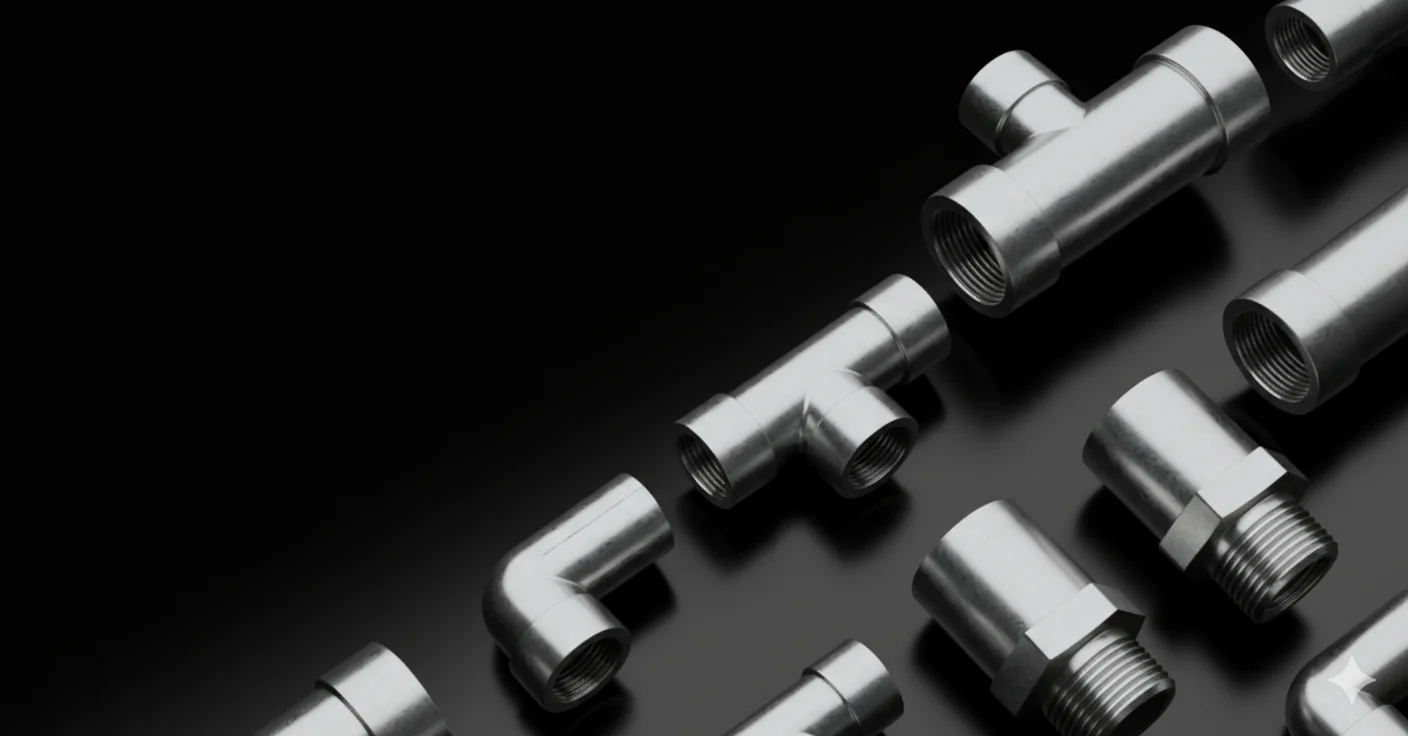
A mixed export order can contain dozens of line items — elbows, tees, reducers, flanges and fasteners in several sizes, grades and heats. When it arrives, the receiving team has to prove that every item on the purchase order is in the crates, correctly identified, and covered by the right certificate. This guide explains how fittings are marked and packed for export, and gives a practical method for reconciling a shipment at receipt.
Three Levels of Identification
Traceability on an export order works at three levels, and each must link to the next:
- Item marking on each fitting or flange — the permanent identity of the part.
- Package marking on each bundle, carton, crate or pallet — what is inside and which order it belongs to.
- Shipping documents — the packing list, commercial invoice and material test certificates that tie packages and items back to the purchase order.
What Is Marked on Each Fitting
Product standards such as ASME B16.9, B16.11 and B16.5 (with MSS SP-25 for marking practice) require each part to carry identifying marks, typically:
- Manufacturer's name or trademark
- Material specification and grade, e.g. WP316L, WPB, F304L
- Size, and schedule / wall thickness or pressure class
- Heat number or heat code linking the part to its certificate
- Additional marks where ordered: dual grade, NACE, PO number or customer tag number
Marking is applied by low-stress stamping, etching, ink stencil or a combination. Stainless steel and nickel alloy parts are normally ink-stencilled or vibro-etched rather than hard-stamped, and small fittings may be tagged where there is not enough surface for full marking.
How Mixed Orders Are Packed
- Segregation: parts are grouped by PO line item, and within a line by heat number, so one package does not mix heats unless agreed. Stainless and carbon steel are kept apart to avoid iron contamination.
- Protection: bevel ends are protected with caps, threaded ends with plastic plugs or caps, and flange faces with covers. Carbon and alloy steel parts receive a rust preventive; stainless parts are kept dry and clean.
- Packaging: small fittings go in cartons, larger items in seaworthy wooden boxes or crates on pallets. Wooden packaging for export is normally heat treated and stamped to ISPM 15.
- Package labels: each package carries a number ("Box 3 of 12"), the consignee, the PO number, the line items inside, gross and net weight, and shipping marks agreed with the buyer.
The Packing List: The Link Between Boxes and Line Items
A useful packing list for fittings is more than a box count. For each package it should show:
- Package number and dimensions / weight
- PO number and line item number for each item inside
- Description, size, schedule or class, and grade
- Quantity per heat number
- The certificate number(s) covering those heats
If you need this level of detail, ask for it in the order. A packing list that only lists totals per line item makes reconciliation much slower at the receiving end.
How to Reconcile a Shipment at Receipt
1. Count packages against the packing list
Check the number of packages and their markings before opening anything. Record any damage to crates on the delivery receipt.
2. Open package by package
For each package, compare the contents with that package's lines on the packing list: description, size, schedule or class, grade and quantity.
3. Check part marking against the list
Read the heat number and grade marked on a sample of parts from every line — or every part, if your quality plan requires it — and confirm they match the packing list.
4. Check heat numbers against the certificates
Every heat number found on the parts should appear on an EN 10204 3.1 (or 3.2) certificate in the document set, with results that meet the grade. Our guide on how to read an EN 10204 3.1 certificate explains what to check.
5. Close out against the purchase order
Tick off each PO line as received in full. Record shortages, excess, wrong sizes or unmarked parts, with photographs, and send them to the supplier quoting the package number and PO line.
What to Specify in Your Order
- Marking method and any extra marks (PO number, tag numbers, colour coding)
- Packing type: cartons, wooden boxes, pallets; ISPM 15 compliance
- End and face protection, and rust preventive requirements
- Whether heats may be mixed within a package
- Packing list format: per package, per line item and per heat number, with certificate references
- Shipping marks and labelling language for the destination
Agreeing these points at the RFQ stage costs nothing and saves days at receipt. To discuss packing and documentation for your order, contact our team, or browse our pipe fittings, flanges and fasteners.
Discuss Packing for Your Order