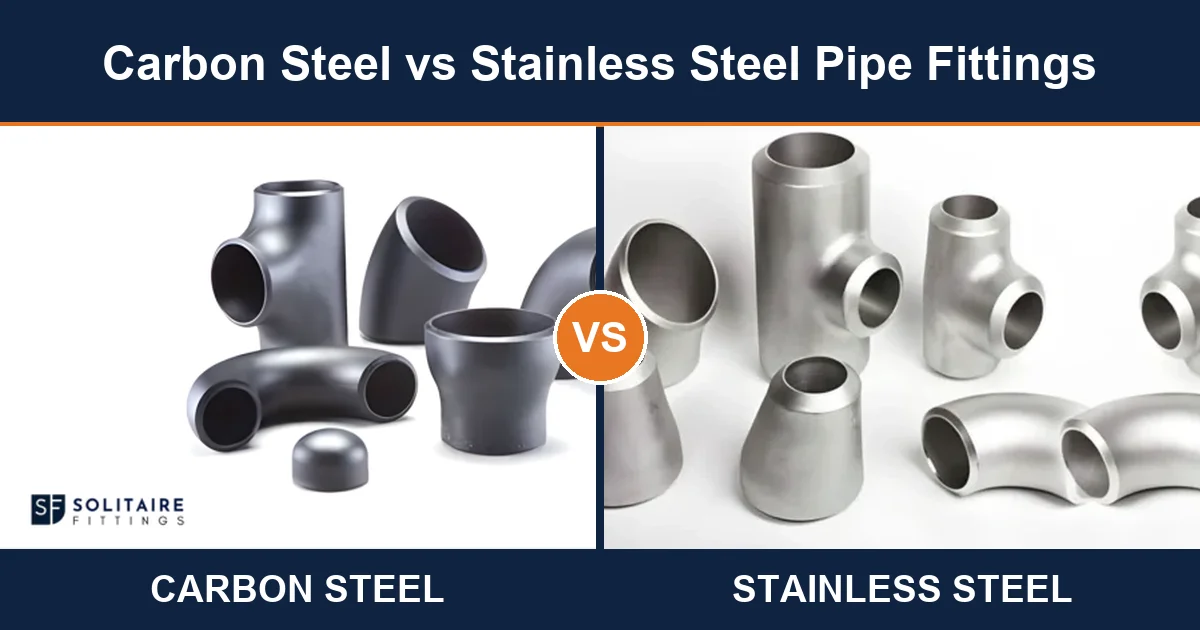
Carbon steel and stainless steel are the two most widely used materials for industrial pipe fittings. Both are strong, available in every standard size, and supplied to well-established ASTM and ASME specifications. But they behave very differently in corrosive, high-temperature and hygienic environments, and their costs are not the same.
So which is better? The honest answer is: it depends on your application. In this blog, we compare carbon steel vs stainless steel pipe fittings on composition, strength, corrosion resistance, temperature, cost and applications, so you can make the right choice for your project.
What Are Carbon Steel Pipe Fittings?
Carbon steel is iron alloyed mainly with carbon (usually up to about 0.30% in fitting grades) plus small amounts of manganese, silicon and other elements. It is strong, tough, easy to weld and economical.
- Buttweld fittings: ASTM A234 WPB, ASTM A420 WPL6 (low temperature), MSS SP-75 WPHY 52/65 (high yield)
- Forged fittings: ASTM A105, ASTM A350 LF2
- Typical finish: Black, painted, galvanised or epoxy coated for corrosion protection
What Are Stainless Steel Pipe Fittings?
Stainless steel contains at least 10.5% chromium, which forms a thin, self-healing chromium-oxide layer on the surface. This passive layer is what gives stainless steel its corrosion resistance. Grades such as 316 also contain molybdenum for better resistance to chlorides.
- Buttweld fittings: ASTM A403 WP304/304L, WP316/316L, WP321, WP347
- Forged fittings: ASTM A182 F304/F304L, F316/F316L, F321
- Typical finish: Pickled and passivated, or polished for sanitary service
Carbon Steel vs Stainless Steel Fittings: Comparison Table
| Property | Carbon Steel (A234 WPB / A105) | Stainless Steel (A403 WP316 / A182 F316) |
|---|---|---|
| Main alloying elements | Carbon, manganese | Chromium, nickel, molybdenum |
| Min. tensile strength | 415 MPa (WPB) / 485 MPa (A105) | 515 MPa |
| Min. yield strength | 240 MPa (WPB) / 250 MPa (A105) | 205 MPa |
| Corrosion resistance | Low – needs coating or corrosion allowance | High – self-protecting passive layer |
| High-temperature service | Good up to about 425 °C | Good oxidation resistance at higher temperatures |
| Low-temperature service | Only special grades (A420 WPL6, A350 LF2) | Excellent toughness down to cryogenic temperatures |
| Weldability | Very good | Good, needs correct filler and procedure |
| Hygiene | Not suitable for food or pharma | Ideal – easy to clean, non-contaminating |
| Magnetic | Yes | Generally non-magnetic (austenitic grades) |
| Initial cost | Lower | Higher |
| Maintenance | Painting, coating, inspection | Minimal |
Key Differences Explained
1. Corrosion Resistance
This is the biggest difference. Carbon steel rusts when exposed to moisture, chemicals or seawater, so it needs paint, galvanising, lining or extra wall thickness as a corrosion allowance. Stainless steel resists corrosion naturally. For chloride-rich or acidic service, 316/316L is usually preferred over 304.
2. Strength
Both materials are strong. Carbon steel fittings such as A234 WPB have a higher minimum yield strength than standard austenitic stainless grades, which makes them very efficient for high-pressure oil, gas and steam lines where the fluid is non-corrosive.
3. Temperature Performance
Carbon steel performs well at moderate temperatures but becomes brittle at low temperatures unless an impact-tested grade such as A420 WPL6 or A350 LF2 is used. Austenitic stainless steel stays tough at cryogenic temperatures and resists scaling at elevated temperatures, which is why it is used in LNG and high-temperature process lines.
4. Cost and Life-Cycle Value
Carbon steel fittings cost significantly less to buy. However, in corrosive environments the cost of coating, inspection, repairs and early replacement can make stainless steel the more economical choice over the life of the plant. Always compare total cost of ownership, not just the purchase price.
When to Choose Carbon Steel Fittings
- Oil and gas transmission pipelines and refinery hydrocarbon lines (see why ASTM A234 WPB fittings are so widely used)
- Steam, boiler feed water and condensate lines
- Fire-fighting and general utility piping
- Structural and high-pressure applications with non-corrosive fluids
- Projects where budget is the main constraint, with supply from India's top carbon steel exporters
When to Choose Stainless Steel Fittings
- Chemical and petrochemical processing with corrosive media
- Food, beverage, dairy and pharmaceutical plants
- Marine, offshore and desalination systems
- Cryogenic and LNG service
- Water treatment and any line where product purity matters
Which Is Better?
Neither material is better in every situation:
- Choose carbon steel for high-pressure, non-corrosive service where cost matters most.
- Choose stainless steel where corrosion, hygiene, low temperature or long maintenance-free life are the priority.
- For very aggressive service, consider duplex stainless steel or nickel alloys.
Always follow your project piping specification and confirm the fluid, pressure and temperature before finalising the material.
Get Carbon Steel and Stainless Steel Fittings from Solitaire Fittings
Solitaire Fittings supplies carbon steel fittings (ASTM A234 WPB, A105, A420 WPL6, A350 LF2) and stainless steel fittings (ASTM A403 and A182 in 304, 316, 321 and more) in buttweld, socket weld and threaded types. Every order comes with material test certificates as per EN 10204 3.1, and our team can help you select the right grade for your application.
Request a Quote for Carbon Steel & Stainless Steel Fittings Today!