Every piping system is only as reliable as its joints. When engineers and buyers specify fittings, one of the first decisions is the end connection: butt weld, socket weld or threaded. Each type has its own pressure rating, size range, installation method and cost. Choosing the wrong one can lead to leaks, failed inspections or expensive rework.
In this guide, we explain the key differences between butt weld, socket weld and threaded fittings, where each one is used, and how to choose the right connection for your project.
What Are Butt Weld Fittings?
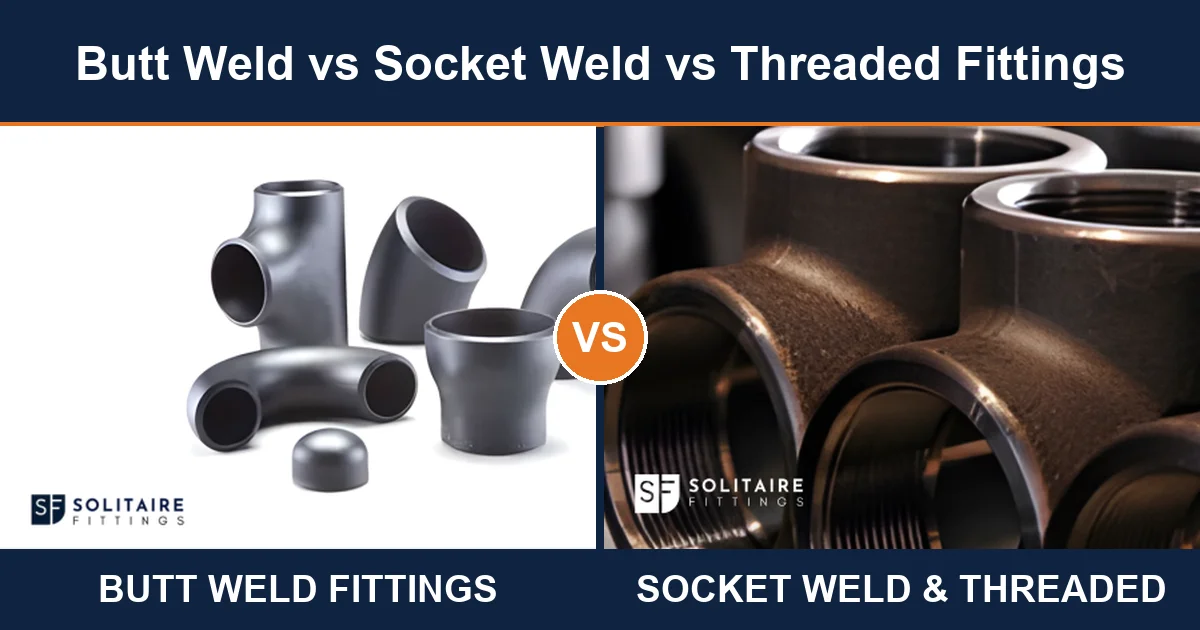
Butt weld fittings have bevelled ends that line up with the bevelled end of the pipe. The two are welded together with a full-penetration weld, so the fitting becomes one continuous part of the pipeline.
- Standards: ASME B16.9 (dimensions), ASME B16.25 (bevel ends), MSS SP-43 (light-wall stainless)
- Size range: Typically 1/2" to 48" and above
- Common products: Elbows, tees, reducers, caps, stub ends and crosses
- Common materials: ASTM A234 WPB, ASTM A403 WP304/WP316, ASTM A234 WP11/WP22, duplex and nickel alloys
Because the weld goes through the full wall thickness, butt weld joints offer the highest strength and a smooth internal bore with minimal turbulence. They are the standard choice for large-diameter, high-pressure and high-temperature lines.
What Are Socket Weld Fittings?
Socket weld fittings have a recessed socket into which the pipe is inserted. A fillet weld is then made around the outside of the joint. Before welding, the pipe is pulled back about 1.6 mm (1/16") from the bottom of the socket to allow for thermal expansion.
- Standard: ASME B16.11
- Pressure classes: 3000, 6000 and 9000
- Size range: Usually up to 2" (small-bore piping)
- Common products: Elbows, tees, couplings, unions, caps, crosses and inserts
- Common materials: ASTM A105, ASTM A182 F304/F316, ASTM A350 LF2, ASTM A182 F11/F22
Socket weld fittings are easy to align, need no bevelling, and give a strong, leak-proof joint for small-bore, high-pressure lines such as instrument, drain and vent piping.
What Are Threaded Fittings?
Threaded fittings (also called screwed fittings) join to the pipe through tapered threads, usually NPT as per ASME B1.20.1 or BSPT. Thread sealant or PTFE tape is used to make the joint leak-tight. No welding is required.
- Standard: ASME B16.11
- Pressure classes: 2000, 3000 and 6000
- Size range: Usually up to 4"
- Common products: Elbows, tees, couplings, plugs, bushings, unions and pipe nipples
Threaded fittings are quick to install and easy to remove, which makes them popular for low-pressure utility lines, maintenance-friendly systems and areas where hot work (welding) is not allowed.
Butt Weld vs Socket Weld vs Threaded Fittings: Comparison Table
| Parameter | Butt Weld | Socket Weld | Threaded |
|---|---|---|---|
| Governing standard | ASME B16.9 | ASME B16.11 | ASME B16.11 |
| Typical sizes | 1/2" to 48"+ | Up to 2" | Up to 4" |
| Joint type | Full-penetration weld | Fillet weld | Tapered thread |
| Pressure capability | Highest | High | Low to moderate |
| Leak resistance | Excellent | Very good | Fair (depends on sealing) |
| Internal flow | Smooth, no crevice | Small crevice at socket gap | Crevice at threads |
| Inspection | Radiography (RT) possible | Surface tests (MPI / DPT) | Visual / pressure test |
| Installation | Skilled welders, bevelling, fit-up | Easier alignment, welding needed | No welding, fastest |
| Dismantling | Cut required | Cut required | Easy to remove |
| Best for | Main process lines, high P/T | Small-bore high-pressure lines | Utility & low-pressure lines |
Advantages and Limitations of Each Type
Butt Weld Fittings
- Advantages: Highest joint strength, leak-proof, smooth flow path, suitable for radiography and long service life.
- Limitations: Requires skilled welders, precise fit-up and more installation time.
Socket Weld Fittings
- Advantages: Easy alignment, no bevelling, strong joint for small-bore high-pressure service.
- Limitations: The 1/16" expansion gap creates a crevice that can trap fluid, so they are often avoided in highly corrosive, radioactive or food-grade service.
Threaded Fittings
- Advantages: No welding, fast installation, easy maintenance and reuse.
- Limitations: Threads reduce the effective wall thickness and can leak under vibration, thermal cycling or high pressure. Not recommended for toxic or flammable fluids.
Where Is Each Type Used?
- Butt weld: Oil & gas pipelines, refineries, petrochemical plants, power plant steam lines and large process headers.
- Socket weld: Instrument tapping, drain and vent lines, chemical dosing lines and small-bore hydraulic systems.
- Threaded: Water, air and lubrication lines, fire-fighting systems, plumbing and temporary installations.
How to Choose the Right Fitting Connection
Before you finalise the connection type, check these points:
- Pipe size: Above 2" is almost always butt weld.
- Pressure and temperature: Higher ratings favour butt weld or socket weld.
- Type of fluid: Corrosive, toxic or flammable media favour butt weld (no crevices).
- Maintenance needs: Lines that need frequent dismantling suit threaded fittings.
- Site conditions: Where hot work permits are hard to get, threaded fittings are practical.
- Project specification: Always follow the piping class and code (ASME B31.1 / B31.3) for your project.
Buy Butt Weld, Socket Weld and Threaded Fittings from Solitaire Fittings
There is no single “best” connection. Butt weld fittings are the strongest option for large and critical lines, socket weld fittings are ideal for small-bore high-pressure piping, and threaded fittings offer speed and flexibility where pressures are lower.
Solitaire Fittings supplies buttweld and forged fittings in carbon steel (including ASTM A234 WPB), stainless steel, alloy steel, duplex and nickel alloys, manufactured to ASME B16.9 and ASME B16.11 with full material test certificates. Our team can help you choose the right connection type, size and pressure class for your project.
Request a Quote for Butt Weld, Socket Weld & Threaded Fittings Today!