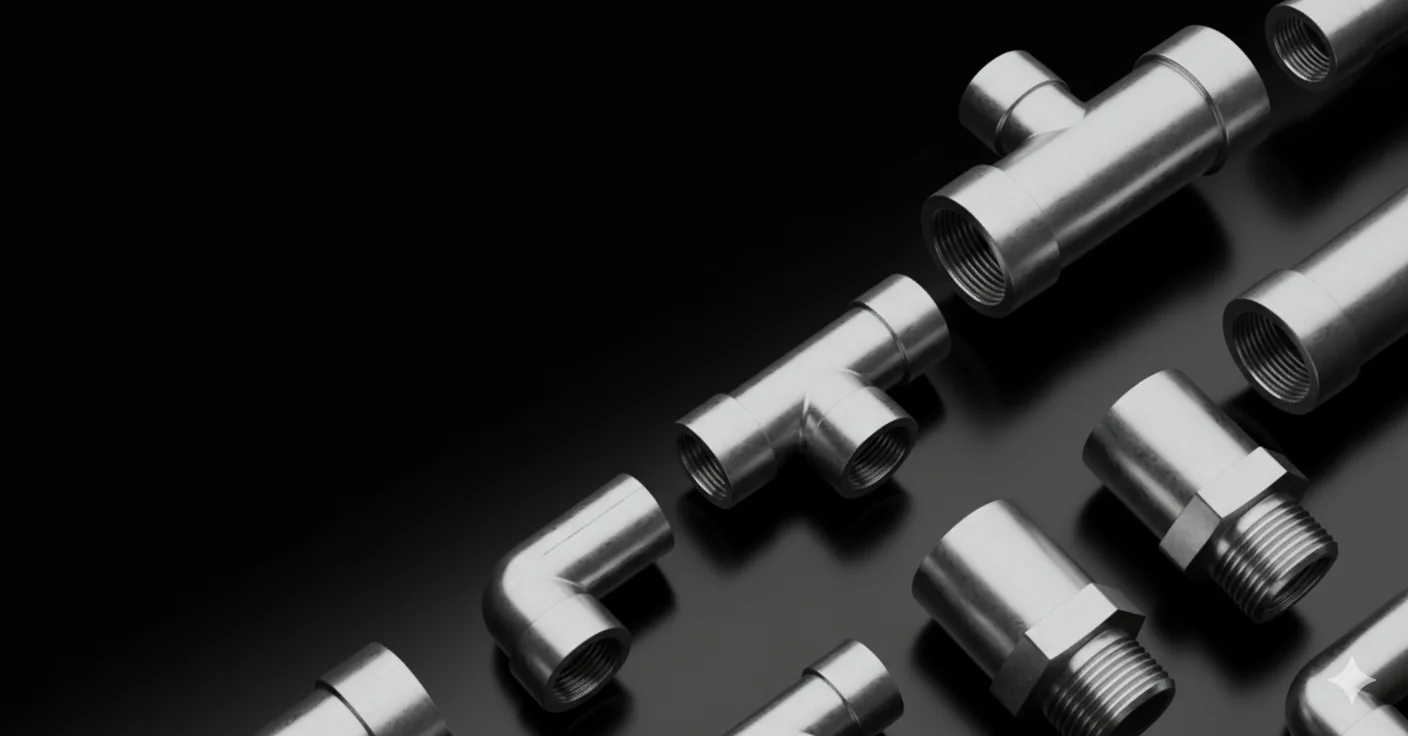
In the food, dairy, and beverage industries, the equipment used is just as critical as the ingredients themselves. The choice of material for piping, valves, and fittings isn't just a matter of mechanical durability—it is a fundamental pillar of food safety and regulatory compliance. While Stainless Steel 304 is common in domestic kitchens, SS 316 (and its low-carbon variant, 316L) is the undisputed industry standard for professional processing environments.
1. The Chemistry of Cleanliness: Why 316 Matters
The primary differentiator between SS 304 and SS 316 is the addition of Molybdenum (usually 2-3%). In a food processing context, this chemical shift provides two vital benefits:
- Chloride Resistance: Many food products—such as brines, soy sauces, and salted meats—contain high concentrations of chlorides. SS 304 is susceptible to "pitting," which are microscopic holes that form on the metal surface. SS 316 resists this electrochemical attack, ensuring the fitting remains smooth and intact.
- Acid Neutrality: From the citric acid in fruit juices to the phosphoric acid used in soft drink production, food processing is a chemically aggressive environment. SS 316 maintains its structural integrity against these organic and inorganic acids far better than lower-grade alloys, preventing metal leaching into the product.
2. Hygiene and the "Biofilm" Battle
The most dangerous threat in food production is the growth of bacteria such as Listeria or Salmonella. Sanitary fittings must be designed to prevent these pathogens from gaining a foothold.
- Surface Roughness ($R_a$): Sanitary fittings are often polished to a specific $R_a$ value, typically $0.8 \mu m$ or less. Because SS 316 is structurally stable, it can achieve and maintain a "mirror finish" more effectively than softer metals.
- The Porosity Factor: Lower-quality metals may have microscopic surface pores. These pores act as "caves" where food particles lodge and bacteria multiply, shielded from cleaning chemicals. SS 316’s dense molecular structure allows for a non-porous surface that is significantly easier to sterilize.
3. Withstanding CIP (Clean-in-Place) Cycles
Modern food plants don't disassemble their entire line to clean it; they use Clean-in-Place (CIP) systems. This involves flushing the fittings with high-temperature water ($80^{\circ}C$ to $90^{\circ}C$) and caustic chemicals like sodium hydroxide or nitric acid.
- Thermal Stability: SS 316 handles repeated thermal cycling (rapid heating and cooling) without warping or losing its seal. This is critical for maintaining leak-proof connections in pressurized lines.
- Chemical Endurance: While CIP chemicals are designed to kill bacteria, they are also highly corrosive to metal. SS 316 ensures that the fittings do not corrode or "pit" during these aggressive cleaning cycles, which would otherwise create new breeding grounds for bacteria.
4. Regulatory Compliance: FDA and 3-A Standards
Using SS 316 isn't just a "best practice"—it is often a legal requirement to meet international safety standards:
- FDA Compliance: The U.S. Food and Drug Administration recognizes SS 316 as a "GRAS" (Generally Recognized as Safe) material for direct food contact.
- 3-A Sanitary Standards: This organization sets the criteria for equipment design. SS 316 is frequently the baseline material required for "Class I" environments where the highest level of hygiene is mandatory.
- EHEDG: The European Hygienic Engineering & Design Group emphasizes the use of 316L to prevent "intergranular corrosion" during the welding of fittings, ensuring that the joints remain as sterile as the pipe itself.
5. SS 316 vs. 316L: The Role of Welding
In sanitary plumbing, most fittings are joined via orbital welding. Standard SS 316 has a carbon content of up to 0.08%. When welded, this carbon can react with chromium to create "chromium carbides," leaving the area around the weld vulnerable to rust—a process known as sensitization.
For this reason, the food industry almost exclusively uses SS 316L (Low Carbon). By reducing carbon to 0.03% or less, the fittings remain corrosion-resistant even at the weld points. This eliminates potential "rust spots" at the joints that could contaminate a batch of product..
Request Your 316/316L Fittings Quote Today!