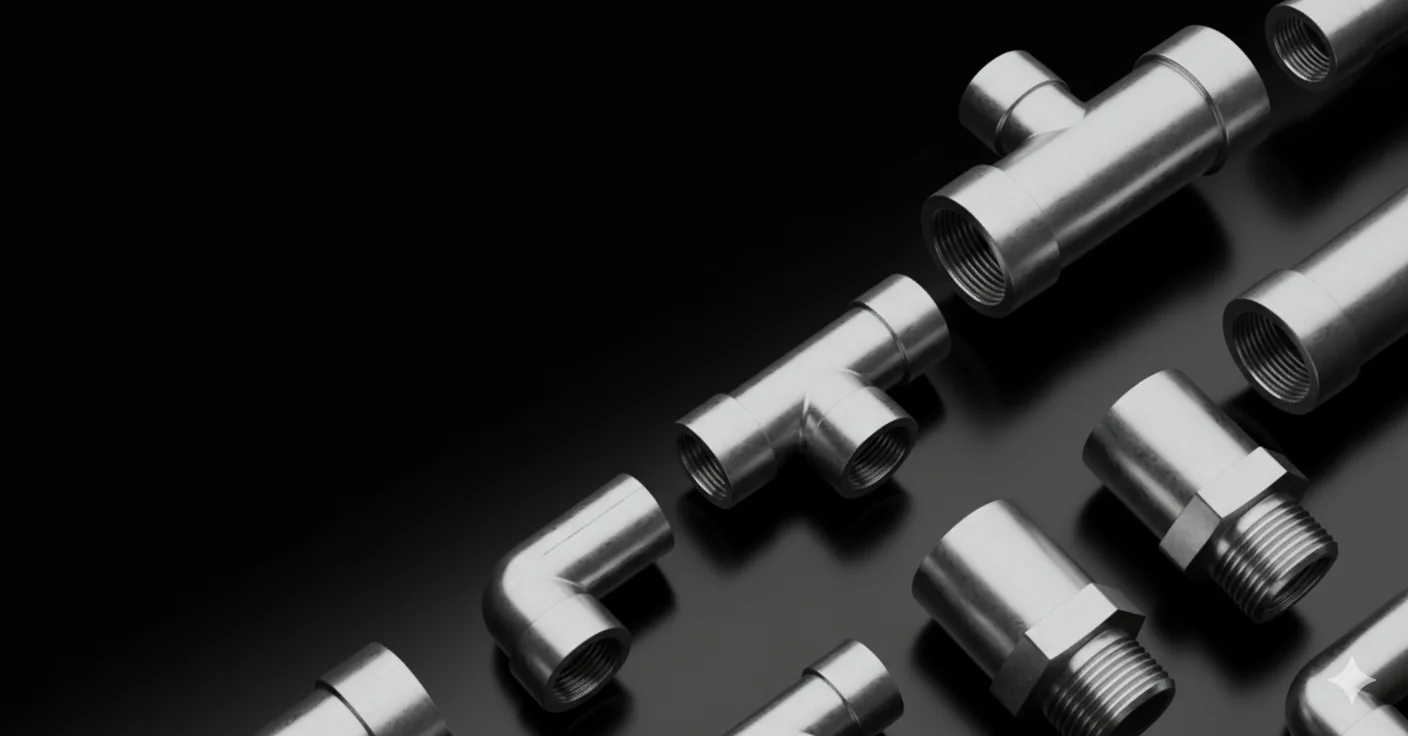
If you look at the piping in a professional kitchen, the fittings in a chemical plant, or even the trim on a modern skyscraper, you are likely looking at Stainless Steel 304 (SS304). It is the undisputed heavyweight champion of the metals industry.
But why? What makes this specific "flavor" of steel so successful? The answer isn't just in how it looks; it is written in its atomic code. To understand the success of 304, we have to look at the chemistry that happens at the molecular level.
1. The "18/8" Blueprint: A Masterclass in Balancing
The most common nickname for SS304 is "18/8 stainless." This refers to the two powerhouse elements that define its chemistry: 18% Chromium and 8% Nickel. This ratio is the "sweet spot" of metallurgy
The Role of Chromium: The Self-Healing Shield
Chromium is the ingredient that turns "steel" into "stainless." In a 304 fitting, the chromium reacts with the oxygen in the surrounding air to create an incredibly thin, invisible layer of Chromium Oxide ($Cr_2O_3$).
This is known as the Passive Layer. Unlike iron oxide (common rust), which is bulky and flakes away to expose more metal to damage, Chromium Oxide is:
- Adherent: It clings to the metal like a second skin.
- Impermeable: It prevents oxygen and water from reaching the iron underneath.
- Self-Healing: If the fitting is scratched or dented, the exposed chromium immediately reacts with the air to "knit" the shield back together.
The Role of Nickel: The Structural Backbone
While Chromium provides the armor, Nickel provides the soul. By adding 8% Nickel, the alloy's crystalline structure is transformed into Austenite. This specific atomic arrangement makes the metal:
- Ductile: It can be drawn into wires or pressed into complex fitting shapes without cracking.
- Tough: It maintains its strength across a massive temperature gradient, from freezing cryogenic tanks to high-heat exhaust systems.
2. The Supporting Cast: Trace Elements with Big Jobs
While the 18/8 ratio gets the glory, the "Chemistry of Success" depends on several minor elements that fine-tune the performance of the fitting.
Manganese (2.0%)Manganese is the unsung hero of the Austenitic structure. It assists the Nickel in keeping the metal non-magnetic and increases the tensile strength. This ensures that when a 304 elbow is under high pressure, it holds its shape instead of deforming.
Silicon (0.75%)During the manufacturing of fittings, Silicon acts as a deoxidizer. More importantly, it increases the fluidity of the molten steel. This allows manufacturers to cast intricate, high-precision fitting shapes—like small-diameter tees or valves—with fewer internal defects.
Low Carbon (<0.08%)In the world of 304, less is often more. Carbon is kept very low to prevent a phenomenon called Sensitization. If carbon levels were higher, the carbon would "steal" the chromium during the heat of welding, forming chromium carbides. This would leave the areas around the weld joints vulnerable to "Intergranular Corrosion." By keeping carbon low, 304 remains highly weldable and durable.
3. Thermal Stability: Success Under Pressure
The chemistry of 304 doesn't just fight rust; it fights the elements. Because of its specific elemental makeup, 304 fittings exhibit remarkable Oxidation Resistance.
In intermittent service, 304 can withstand temperatures up to 870°C (1600°F). In continuous service, it remains stable up to 925°C (1700°F). This is why you see 304 fittings used in everything from food pasteurization (heat) to liquid nitrogen transport (cold). Its face-centered cubic (FCC) atomic structure prevents it from becoming "brittle" in the cold, a common failure point for cheaper carbon steels.
4. Why It Wins: The Economic Chemistry
The final reason for the "Chemistry of Success" is Value. There are "better" steels, like SS316, which adds Molybdenum to fight salt-water corrosion. However, Molybdenum is expensive. SS304 provides enough protection for 90% of global applications—food, water, architectural, and light chemical—without the heavy price tag of more exotic alloys. It is the "Goldilocks" of fittings:
- Stronger than plastics.
- Cheaper than high-nickel alloys.
- More durable than carbon steel.
Summary
The success of the 304 fitting is a result of a perfectly balanced chemical formula. By combining the self-healing properties of Chromium with the structural stability of Nickel, metallurgists created a material that is virtually immortal in the right conditions. It is a testament to how a few precisely measured elements can change the world of infrastructure forever.
Request Your 304 Fittings Quote Today!